
Ensemble Ensemble
Menu
Home
  • SOLUTIONS
  • Method
    • A Systemic Approach
    • Theory of Constraints
    • Working with us
  • RESOURCES
    • Productivity Scorecard
    • Articles
    • Subscribe
    • Our book
  • Results
  • ABOUT
    • The Just Work Manifesto
    • Our Story
    • Location
Book a call
loader

Operations | Organisation | People | Process | Strategy

View all articles SUBSCRIBE TO NEWSLETTER to get articles and more

STAY CONNECTED AND SIGNUP TO RECEIVE INSIGHT updates

Subscribe

Capability Maturity

David Hodes, Founder

What are you and your organisation capable of doing? By when? For how much? How quick are you? How reliable? What steps are you taking to improve your performance, and what does the end state look like?

[Listen to audio version, read by David Hodes]

What we’re talking about when we address those questions is your organisation’s capability. We can define capability as the ability to perform or achieve certain actions or outcomes through a set of controllable and measurable faculties, features, functions, processes or services.

The possibly apocryphal story goes that the US department of defence became thoroughly disenchanted with the idea of paying exorbitant amounts for not very much when procuring their products and services on a cost-plus basis. However, the nature of their procurement was such that they couldn’t really nail down a precise scope. Moreover, the risk was too significant for most vendors to offer a fixed price when the advanced technologies they were developing contained such colossal uncertainty. So the US government put out a tender to solve the problem, which Carnegie Mellon University ultimately won. They were the institution that created what we have now come to know as the CMMI or Capability Maturity Model Integration. The CMMI is a process level improvement training and appraisal program administered by the CMMI Institute.

The illustration below provides a graphic view of the intention of the CMMI when applied across its five maturity levels, being initial, managed, defined, quantitatively managed and optimising:

In brief, the application of the CMMI enables repeatable success over the long haul. It is no instant panacea but instead provides a framework to systematically lift both the capability and maturity of an organisation’s people. The three critical dimensions which make up the capability model are: procedures and methods defining relationships and tasks; people with skills, training and motivation; and tools and equipment.

To get a richer rendering of what these mean, let’s take a stroll through an example.

Five levels of maturity

Imagine you work in an industrial organisation that has several operations in different parts of the world. Let’s say our organisation has a profound capability in engineering. Based on the amount and complexity of any given project, those projects are allocated either to the Major Projects services of group functions or to the local engineering function of the given operation. In addition, at the local level, the operation undertakes heavy maintenance and is accountable for controlling all the self-performed, consulting and contracting work associated with doing so.

We observe when we ask some questions that although each of these business areas does project management—in that they need to deploy resources to define a scope of work to be completed to a desired timeline and budget—there is little consistency between them.

Thus, for example, heavy maintenance runs late in determining the scope, rather primitively defines a labour and materials plan in a multitude of spreadsheets, and has a rudimentary schedule used solely for high-level reporting purposes. The work management is done by the maintenance manager, based on years of experience and their tacit understanding of what needs doing.

However, they rarely, if ever, meet their promised return-to-service dates, often forego scope items because of time pressure, and overspend labour budgets by reactively addressing crisis after crisis by throwing people at them. This scenario would be an example of an initial level of maturity.

We swing past engineering and are pleased to see that, for their projects, they can show you a schedule in one of the popular scheduling tools. But, of course, different project managers have their own ideas of what makes for a good enough schedule and, in the absence of a standard, they do the best they can.

These engineers pride themselves on the fact that their plans are end-to-end; that is, each of the phases have detailed schedules. In addition, the deliverables required to go through the mandated tollgates are listed, the completion of which will allow funding for each of the phases.

As a result, the engineering department is more reliable in terms of timeliness and costs than their heavy maintenance colleagues. However, there are still issues with rework, and everyone knows that if they were better organised, especially across the silos, they could be more productive. This scenario would be an example of a managed level of maturity.

We leave the operations and head into the big smoke, where the heavy hitters from major projects hang out. They have a plethora of veterans of the world of project management and have a whole compendium of rules and tools required to plan and execute their big, costly, complex projects. They are strong on governance, steering committees, and standardised reporting frameworks.

Because they are a centralised function, they service all operational units within the organisation. Thus, they are more inclined to standard ways of working, as anyone from their team could end up on any of their projects at a moment’s notice. It helps with productivity if everyone is well versed in the rhythms and routines of standardised ways of working.

From the vantage point of the major projects’ function, they can collect linked projects into programs of work and can further aggregate them into defined portfolios. Their people are given the training and develop the skills necessary to professionally manage the complexity associated with their portfolios. And, they are equipped with industrial-strength tools for the planning and execution of their work.

The stakes are much higher in the major projects arena than in engineering or heavy maintenance, with a bad project having the potential to cause material damage to the organisation. So a lot more attention is paid to governance and how that flows through to the management of risk and performance. This scenario would be an example of a defined level of maturity.

Expanding across the enterprise

One day, you wake up and wonder what would happen if you were to take an enterprise view across all of your projects, be they maintenance, engineering or major? You get excited about the vision and go about the work of defining and collecting relevant data.

You create a standardised resource taxonomy and develop a scheduling standard that is mandated across the enterprise. Then, you take the best of what you have in areas such as procurement, risk, HR, safety, performance and communications management – amongst others –and incorporate them into your governance framework.

You invest heavily in your teams’ training in the new ways of working and in the technology needed to provide the information necessary to run all your projects in a consistent fashion across the enterprise. You can compare one project’s performance against another’s using a standardised set of data and criteria.

Internal and external stakeholders notice the significant improvement in your ability to reliably deliver what you promised in ever-shorter turn times. Even the chief beancounter is your friend as you and your teams consistently hit or exceed budget expectations. And, it keeps getting better as everyone is motivated by the living idea and shared experience of continuous improvement. This scenario would be an example of a quantitatively managed level of maturity.

Anyone reviewing your organisation finds that you are both stable and flexible at the same time. Everyone involved is focused on continuous improvement, allowing you to fend off any threat and seize every opportunity.

There is an intrinsic appetite for change, but based on a stable platform of capable people using standard processes and fit-for-purpose tools. The teams have an ever-growing sense of being at one, with an aligned and shared vision, in service of a grand and ennobling mission.

Over many years, you have done the hard yards of attaining mastery and relish the idea of improving it for good. This scenario would be an example of an optimising level of maturity.

The table below gives a tangible sense of the process areas covered by the capability maturity model for services. The process category abbreviations used in the table are as follows:

PcM – Process Management
PWM – Project and Work Management
SED – Service Establishment and Delivery
Sup – Support
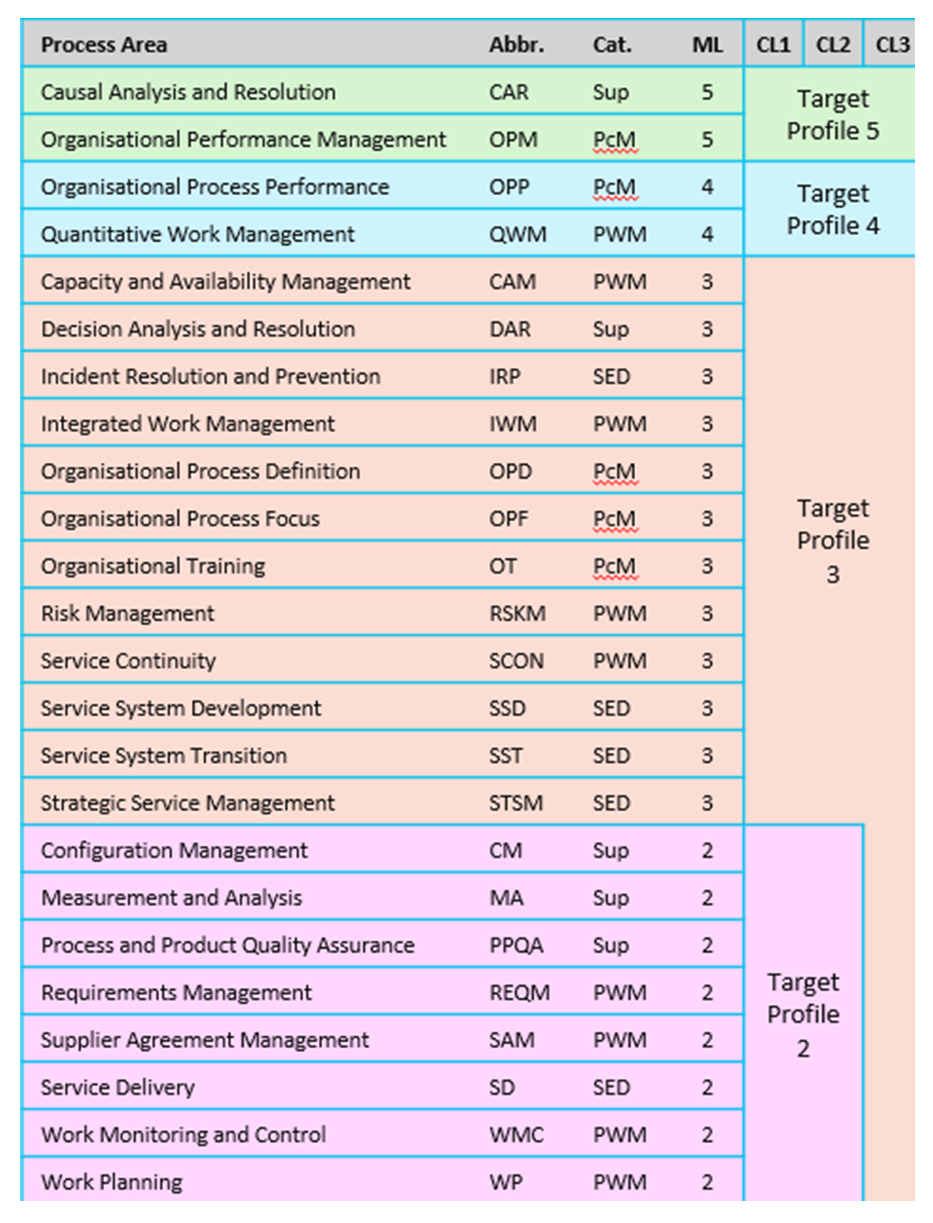
There are no shortcuts to attaining capability maturity. For example, you cannot skip a level outlined in the target profile, as each process area builds on the others. Getting and sustaining the target profile at level 5 is a years-long endeavour applying what Deming would have called consistency of purpose. The prize, however, is an unbeatable sustainable advantage and a remarkable opportunity for learning and growth.

____________________________

What’s next?

To get a flavour of the cohort experience, come to the Systems Thinker Foundations Workshop. It’s free, and you’ll leave with a framework you can immediately apply to your organisation. I hope you’ll join me.

Got a more urgent challenge? Schedule a free call with me.

We’d love to run it with you. To learn more:

  • download the brochure (no email required)
  • schedule a call
    ____________________________Man on his back

    [Background image: Man on his back, on Shuttershock]

    ____________________________

  • Culture
  • Operations
  • Process
  • Strategy

The healthcare professional: the hidden constraint in patient flow

Ensemble Administrator

Healthcare professionals are central to the patient’s progress from awareness of a therapy to successful long-term use. They identify risk, interpret evidence, diagnose conditions, discuss options, perform procedures, provide training and monitor outcomes.

Yet many medical device development programs treat healthcare professionals primarily as users to be trained or customers to be persuaded.

HCP-Centered Design takes a wider view. It examines the work healthcare professionals must perform, the system in which they perform it and the constraints that limit their ability to move suitable patients through the care pathway.

“If patient flow depends on a healthcare professional, that professional’s available capacity may determine how many patients ultimately receive the therapy.”

Healthcare professionals govern critical transitions

A medical device patient journey commonly depends on several healthcare professionals:

  • A primary care professional recognizes a problem or makes a referral.
  • A specialist assesses the patient and manages the disease pathway.
  • Diagnostic professionals generate and interpret evidence.
  • A managing physician supports authorization or reimbursement.
  • An interventional specialist confirms eligibility and performs a procedure.
  • Nurses, educators or allied health professionals help the patient adapt.
  • Follow-up teams monitor efficacy and coordinate adjustments.

Each professional governs a transition in the flow of patients.

If one transition lacks sufficient capacity, information or clarity, the whole pathway slows. More marketing, sales activity or production capacity will not compensate for a shortage of specialist time or a burdensome diagnostic process.

This is why HCP-Centered Design is not simply about making an interface easier to use. It is about enabling the system of care to perform.

The HCP works within a system

A healthcare professional’s work depends on information and actions supplied by others. They may rely on referrals, patient histories, pathology, imaging, electronic records, clinical guidelines and the availability of equipment or trained colleagues.

After reaching a decision, they may need to explain it, document it, arrange authorization, coordinate treatment and prepare the next person in the pathway.

A technically strong solution can still create difficulty if it:

  • Requires information that is hard to obtain
  • Interrupts established clinical workflows
  • Produces outputs that are difficult to interpret
  • Adds documentation without removing other work
  • Fails to connect with existing systems
  • Demands training that cannot be sustained
  • Transfers work or risk to another professional
  • Provides a result without clarifying the next action

The relevant design question is not merely, “Can the HCP use this product?”

It is, “Does this solution improve the HCP’s ability to complete important clinical work within the conditions in which care is actually delivered?”

Identify the real healthcare professional personas

“HCP” is not one persona.

A general practitioner, specialist, interventional physician, nurse, technician and clinical administrator encounter different stages of the pathway. Each has different responsibilities, authority, expertise and exposure to risk.

Even within a profession, context matters. An experienced specialist in a major hospital may approach the same task differently from a professional who encounters the condition infrequently or works without immediate specialist support.

Useful HCP personas distinguish factors that influence work:

  • Clinical responsibility and decision authority
  • Frequency of encountering the condition
  • Experience with the procedure or technology
  • Access to information and specialist support
  • Available time
  • Confidence in interpreting results
  • Responsibility for follow-up
  • Exposure to clinical, legal or financial risk

These personas clarify who performs each job and what support each person requires.

Map the HCP journey

The HCP journey often begins before the visible clinical procedure.

It may include receiving a referral, gathering information, forming an initial view, ordering investigations, interpreting results, deciding whether the patient is eligible, discussing treatment, obtaining authorization, preparing for the procedure, delivering care and arranging follow-up.

At each stage, ask:

  • What is the HCP trying to accomplish?
  • What information is required?
  • Where does the information come from?
  • What decision must be made?
  • What could cause delay or rework?
  • Who depends on this action?
  • What must happen before the patient can progress?

The resulting journey map should distinguish processing time from waiting time. A decision may require only minutes of specialist attention while patients wait weeks to access that attention.

This reveals the practical relationship between HCP capacity and patient flow.

Find the HCP constraint

The Theory of Constraints directs attention to the factor limiting the performance of the entire system.

In some pathways, the constraint may be the number of qualified interventional specialists. In others, it may be diagnostic capacity, physician confidence, authorization effort, operating room access or the time required to train patients.

The constraint may also be hidden inside the HCP’s working day.

A specialist supporting a therapy must still manage other clinical duties, administration, meetings, documentation and urgent cases. The question is not simply how many specialists exist. It is how much of their usable capacity is available for the activities upon which patient flow depends.

“The scarcest resource may not be the healthcare professional. It may be the few hours of focused capacity available for the critical work.”

Improvement away from this constraint can make performance worse. Sending more referrals to an already overloaded specialist increases the queue. Adding information may increase cognitive burden. Creating another approval may consume the capacity required to treat patients.

HCP-Centered Design seeks to protect and expand the capacity that governs flow.

Go to the clinical Gemba

Policies and procedures describe how clinical work should happen. Observation reveals how it actually happens.

Healthcare professionals routinely compensate for missing information, awkward interfaces and unreliable handovers. These workarounds may become so familiar that nobody reports them as problems.

Gemba research should examine:

  • How the HCP prepares
  • Which tools and information sources are used
  • What interrupts the work
  • Where the HCP waits or repeats activity
  • How uncertainty is communicated
  • What must be documented
  • How work passes to the next person
  • How the HCP recognizes that the job is complete

The purpose is not to judge the healthcare professional. It is to understand the system surrounding the work.

“A workaround is often evidence that the system has failed to support the person doing the work.”

Define the HCP’s job to be done

Healthcare professionals do not simply use devices. They use them to make progress in clinical work.

An HCP may need to identify risk, reach a confident diagnosis, select an intervention, perform a procedure safely, explain options, monitor progress or recognize deterioration.

A structured job map divides this work into eight stages:

  1. Define the intended clinical outcome.
  2. Locate the necessary information and resources.
  3. Prepare the patient, equipment and environment.
  4. Confirm readiness and choose between alternatives.
  5. Execute the clinical activity.
  6. Monitor its progress and results.
  7. Modify the approach when circumstances change.
  8. Conclude, document and prepare for subsequent care.

This wider view prevents the product team from concentrating exclusively on the procedure.

The greatest value may come from reducing preparation, improving decision confidence, clarifying an exception, simplifying documentation or improving the handover to follow-up care.

Convert experience into measurable outcomes

Comments such as “the interface is difficult” or “we need better information” indicate dissatisfaction, but do not provide sufficient direction for design.

They should be translated into measurable outcome statements, such as:

“Minimize the time required to identify which clinical information is missing before making a treatment decision.”

Or:

“Reduce the likelihood that a clinically significant change goes unrecognized between scheduled reviews.”

A broader population of healthcare professionals can then assess the importance of each outcome and their satisfaction with their current ability to achieve it.

Highly important and poorly satisfied outcomes provide a rational basis for prioritizing innovation.

“Adoption follows when a solution makes important clinical work safer, clearer or easier to complete.”

Apply FOCUS to HCP capacity

The five-step FOCUS process creates a practical improvement cycle.

Find the constraint. Determine which HCP activity or resource currently limits patient flow.

Optimise for it. Protect the constraint from avoidable work, missing information, interruptions and rework.

Collaborate around it. Align upstream and downstream teams so patients, information and resources arrive when required.

Uplift it. Add capacity, redesign responsibilities, improve technology or remove restrictive policies.

Start Again. Identify the new constraint once flow improves.

This approach allows the organization to distinguish activity from value. It also turns HCP engagement into an ongoing management discipline.

Connect HCP evidence with enterprise execution

HCP-Centered Design must connect clinical reality with patient needs, technology, regulation and business strategy.

A Value Management Office can help coordinate these perspectives across the product lifecycle. Its role is to ensure that projects, resources and stage-gate decisions remain connected to patient flow and business value.

The organization should be able to show:

  • Which HCP groups influence the pathway
  • What each group is trying to accomplish
  • How the work happens in practice
  • Which outcomes remain poorly served
  • Where HCP capacity constrains patient flow
  • How the proposed solution changes the wider care system
  • How improvement will be measured

The goal is not simply a device that healthcare professionals can operate. It is a solution they can confidently incorporate into care and a delivery system capable of getting that solution to more patients.


What’s next?

Use the HCP-Centered Design assessment to determine how well your organization understands clinical work, HCP capacity and the constraints governing patient flow.

The resulting evidence should guide product design, process improvement and investment toward better products, delivered faster, with more lives changed for good.

READ MORE

  • Operations
  • People
  • Process
  • Strategy

Patient flow: the missing system in Patient Centered Design

Ensemble Administrator

Medical device companies devote enormous skill and investment to developing safe, effective products. Yet a technically successful device changes no lives while suitable patients remain unable to reach it.

Between a patient becoming aware of a therapy and receiving its intended benefit lies a pathway of referrals, consultations, diagnostics, approvals, procedures, training and follow-up. Every step consumes time. Between the steps, patients wait. At some points, they become confused, discouraged, ineligible or lost to the process.

Patient Centered Design must therefore address more than the design of the device. It must improve the performance of the entire system through which patients reach, receive and live successfully with the solution.

“A life-changing therapy changes no lives while patients remain trapped in the pathway leading to it.”

The patient journey is a flow system

A typical medical device journey may include:

  1. The patient becomes aware of a possible therapy.
  2. A primary care professional or specialist assesses the patient.
  3. Diagnostic work determines whether the therapy is appropriate.
  4. The patient secures authorization or reimbursement.
  5. An interventional specialist confirms and plans the procedure.
  6. The patient receives the device or therapy.
  7. The patient learns how to live with the solution.
  8. Follow-up identifies any necessary adjustments.
  9. Periodic reviews monitor longer-term efficacy.

Companies often manage these stages as separate functions. Marketing works on awareness. Medical affairs supports clinicians. Market access addresses reimbursement. Sales works with specialists. Clinical teams gather evidence. Training teams support adoption.

The patient, however, experiences one journey.

From the patient’s perspective, a delay between two organizational functions remains a delay. A repeated test remains repeated work. An unclear handover creates uncertainty regardless of which department owns it.

Patient Centered Design begins when the organization sees and manages this journey as a connected system.

Processing time tells only part of the story

Every step contains some necessary processing time. A consultation takes time. A diagnostic test takes time. An authorization must be assessed. A procedure must be performed.

The patient’s total lead time, however, also includes the waiting between these activities.

A consultation may take 30 minutes, but the patient could wait six weeks for it. A diagnostic test may take an hour, followed by another delay before a specialist reviews the result. Prior authorization may require little actual work while adding weeks to the pathway.

This distinction matters because organizations often improve processing time while leaving the larger queues untouched. Saving five minutes during an appointment produces little benefit if the patient waits months to reach it.

Patient Centered Design therefore asks:

  • How long does each activity take?
  • How long do patients wait between activities?
  • How many suitable patients enter each stage?
  • How many progress to the next stage?
  • Where and why do patients leave the pathway?
  • How much total time passes before the patient receives the solution?

The answers reveal the true performance of the patient system.

Find the constraint

Theory of Constraints teaches that the performance of any system is limited by a constraint. Improving a part of the system that is not constraining flow may create more activity without increasing results.

If diagnostic capacity is the constraint, generating more awareness may simply produce a longer queue for diagnosis. If specialist capacity is the constraint, accelerating authorization may move patients more quickly into another wait. If training after first use is inadequate, increasing procedures may produce poor experiences and avoidable follow-up demand.

“More activity at a non-constraint creates work in process. More capability at the constraint improves the system.”

The constraint is not always a physical resource. It may be a policy, an eligibility rule, missing evidence, a fragmented handover, an information delay or the cognitive burden placed on the patient.

The most important question is therefore not, “How do we improve every step?”

It is, “What currently limits the flow of suitable patients to successful use of the therapy?”

Understand why patients remain in or leave the flow

Numbers show where patients are lost. Patient research helps explain why.

Two patients with the same diagnosis may respond very differently. One may actively seek new treatment options. Another may delay action until symptoms become severe. A third may want help but lack confidence in navigating the healthcare system.

Meaningful patient segmentation considers characteristics that influence behavior:

  • The importance the person gives their health
  • Their confidence in dealing with healthcare professionals
  • Whether they act independently or need encouragement
  • Their comfort with technology
  • The pressures of work, family and daily life
  • Their ability to understand and act on clinical information
  • Their willingness and ability to pay
  • The outcomes they most want to achieve

These differences affect whether patients enter the pathway, remain engaged and successfully adopt the solution.

Go to the patient’s Gemba

The Gemba is the place where work actually happens. For patients, this includes the home, clinic, hospital and all the places where they manage their condition between formal encounters.

Interviews alone may miss important evidence. People normalize inconvenience, forget workarounds and simplify their past decisions. Observation allows the development team to see what patients actually do.

Good research combines three activities.

Observe. Watch how patients obtain information, prepare, use the solution and respond when something goes wrong.

Immerse. Understand the physical, emotional and practical conditions surrounding the experience.

Engage. Ask open questions that allow patients to describe their goals, fears and frustrations in their own language.

The purpose is to discover the patient’s reality before asking them to evaluate the organization’s preferred answer.

Understand the patient’s job to be done

Patients rarely want a medical device for its own sake. They want the progress it may enable.

They may want to recognize deterioration earlier, preserve independence, reduce pain, avoid repeated visits, return to work or prevent a disease from controlling daily life.

A useful job map examines eight recurring stages:

  1. Define what must be achieved.
  2. Locate the required information and resources.
  3. Prepare for the activity.
  4. Confirm readiness and choose between alternatives.
  5. Execute the activity.
  6. Monitor whether it is working.
  7. Modify the approach when circumstances change.
  8. Conclude or prepare for what follows.

This reveals opportunities beyond the immediate use of the device. The most valuable improvement may involve helping patients prepare, confirm readiness, recognize an exception or understand what happens next.

Turn patient experiences into evidence

Stories create understanding, but investment decisions require structured evidence.

Patient observations and comments should be converted into outcome statements that identify:

  • The desired direction of improvement
  • A measure of success
  • The object being controlled
  • The circumstances in which it matters

For example:

“Minimize the time required to recognize that my condition has changed sufficiently to require clinical help.”

Patients can then assess the importance of each outcome and their satisfaction with their current ability to achieve it.

Highly important and poorly satisfied outcomes represent genuine opportunities. This prevents teams from prioritizing attractive features that do not materially improve the patient’s life or progress through the pathway.

“Innovation becomes valuable when it improves an outcome that matters and remains poorly served.”

Apply the five-step FOCUS process

The Patient Centered Design pathway can be improved through a repeating discipline:

Find the constraint. Identify what currently limits patient flow or successful use.

Optimise for it. Make the best possible use of existing constraint capacity.

Collaborate around it. Align functions and partners so their actions support the constraint.

Uplift it. Add capability, remove restrictive policies or redesign the pathway.

Start Again. Once the constraint moves, identify and address the next limiting factor.

This prevents improvement from becoming a collection of disconnected initiatives. It directs scarce resources toward the factor that most strongly governs the result.

Patient Centered Design is an operating system

Patient insight should influence more than early product design. It should shape clinical evidence, regulatory strategy, reimbursement, manufacturing, education, market development and post-market support.

The organization should be able to show:

  • Which patients it intends to serve
  • What those patients are trying to accomplish
  • How the complete patient pathway operates
  • Where patients wait or leave the flow
  • Which outcomes remain poorly served
  • What currently constrains successful patient access
  • How the proposed solution improves the whole system

The goal is not simply to place the patient at the center of a diagram. It is to organize the enterprise around delivering better products faster, so that more lives can be changed for good.


What’s next?

Use the Patient Centered Design assessment to determine how well your organization understands its patient journeys, priority outcomes and constraints to patient flow.

The result should be more than another collection of patient opinions. It should provide evidence that directs strategy, investment and execution toward the changes that matter most.

READ MORE

More than just work

Discover better ways to do better work.

Fresh insights, every Friday

We alternate our own actionable articles with three relevant links from other authorities.

We’ll only use your email address for this newsletter. No sales calls

    Subscribe to 'Perspectives'

    [recaptcha id:cf7note]

    More Than Just Work
    Weekly productivity insights

    Subscribe
    • EnsembleConsultingGroup
    • Share Page
    • +61 2 9387 3955
    • info@EnsembleConsultingGroup.com

    Site proudly designed by Brand Fibre

    What is to get in touch with you?


    More than just work

    Discover better ways to do better work.

    Fresh insights, every Friday

    We alternate our own actionable articles with three relevant links from other authorities.


    We’ll only use your email address for this newsletter. No sales calls

    white_arrow white_bidirection_arrow arrow-right-green arrow-right-orange arrow-right arrow-left blue_arrow blue_round_arrow tick

    Want us to get in touch with you?

     
    Thank you for your interest. We will call you back.