
Ensemble Ensemble
Menu
Home
  • SOLUTIONS
  • Method
    • A Systemic Approach
    • Theory of Constraints
    • Working with us
  • RESOURCES
    • Productivity Scorecard
    • Articles
    • Subscribe
    • Our book
  • Results
  • ABOUT
    • The Just Work Manifesto
    • Our Story
    • Location
Book a call
loader

Culture | Language | Organisation | People | Strategy

View all articles SUBSCRIBE TO NEWSLETTER to get articles and more

STAY CONNECTED AND SIGNUP TO RECEIVE INSIGHT updates

Subscribe

Cultivating culture

David Hodes, Founder

Legendary management guru Peter Drucker never actually said, ‘Culture eats strategy for breakfast’. But the epigram stuck. In fact, the two are entangled; an effective strategy requires an enabling culture.

This is Part 1 | Read Part 2 | Part 3

[Listen to audio version, read by David Hodes]

But what is culture? When asked this question, many provide the tautologous answer ‘the way we do things around here’. Such a response does not help answer the critical questions of a given organisation’s culture at a given time in its history, and how a productive and generative culture might be cultivated into the manageable horizon.

Much of my understanding of culture comes from the work of Emeritus Professor Ed Schein, who founded the Centre for Organisational Learning at the MIT Sloan School of Management. Schein’s model invites us to look at three levels of culture: artefacts, espoused beliefs and values, and basic underlying assumptions.

The iceberg metaphor is helpful here in that what we see at the top, above the waterline, is the manifestation of what is going on at a much deeper level. You may walk into an office or worksite and look at the general presentation of the work environment. Is it tidy, freshly painted, filled with light, or dark and dingy? Are the spaces intentionally set out like an Apple Store, or is it all rather more like the office of an inundated cohort of junior law clerks? How do people behave towards each other? Are they competitive or collaborative? Bureaucratic or in flow? Cynical or inspired? Family-like or formal? These are artefacts. But even with these, it’s not easy to know what’s really going on, based only on simple observations of what our senses feed to the meaning-making machine of our minds.

Dig a bit deeper, and we are in the realm of espoused beliefs and values. Espoused because they are what we read on the posters, see on the presentations, and hear from the functionaries when we ask questions about ideals, goals, values, and aspirations. When we notice a discrepancy between the espoused values and the actual behaviours, we’re likely to be fed some well-rehearsed rationalisations: ‘Mary’s behaviour is not congruent with our publicly stated value of inclusion, and we have had a lot of complaints about her abrasive and demeaning management style. Still, her personal story allows us to help her more fully activate the better angels of her nature, as, despite everything else, she delivers the results the business is looking for.’

Down at the deepest level, we are into the realm of the unconscious—the same domain that informs the myths we live by. In that domain, we answer the questions about the meaning and purpose of our lives, how we got here, and what we will do with the finite time we have left. In a productive culture, there is a deep congruence of value at all the levels within which we operate: the personal, the team, the organisation, and the society in which we live.

External adaptation and internal integration

Arriving at such a state of harmony within an organisational setting is never easy. We have two significant challenges to overcome: external adaptation and internal integration. Before exploring these two challenges in more depth, it is worth quoting Schein’s definition of culture in full:

‘The culture of a group can be defined as a pattern of shared basic assumptions learned by a group as it solved its problems of external adaptation and internal integration, which has worked well enough to be considered valid and, therefore, to be taught to new members as the correct way to perceive, think, and feel in relation to those problems.’

In other words, what we learn about solving the problems of external adaptation and internal integration and how we examine the assumptions that inform that learning is of the essence to culture formation.

External adaptation includes understanding how we get to play our game within the markets in which we compete. We need to articulate our mission and strategy in a way that all critical stakeholders understand. We must embrace the question that asks what the fundamental problem is that we solve for those who consume our products or services? Given our mission, what is our goal? At least how much of what, by no later than when? How must the accountability hierarchy be constructed to best serve the processes which deliver on the mission? What means will we need to secure to accomplish our mission? How is the division of human, financial, material and information resources determined and allocated? What will we measure, and how could those measures be used to control progress towards our stated goal? How will we develop a consensus on the when and what of course corrections? What are the appropriate remedial or repair strategies to be used if goals are not being met?

Internal integration proves a more challenging arena for us to understand. It begins with the idea of creating a common language, where words and conceptual categories have shared meaning. As an example, think of the number of acronyms we demand a recruit learns before they come to readily understand the local dialects. The idea of internal integration begs the question of the extent to which the integration applies. What is the boundary for inclusion, and who, then, is in or out? By what criteria is membership determined?

Once we know the group’s boundary, each must work out its pecking order, criteria, and rules for how someone gets maintains and loses power and authority. Consensus in this area is crucial to help members manage feelings of aggression. If there are no rules around the exercise of power, we trigger that primal aggressive response associated with unfair authoritarianism.

How is the game played?

Over time, every group must work out its ‘rules of the game’ for peer relationships, relationships between the sexes, and how openness and intimacy are handled in managing work. Consensus in this area is crucial to help us define trust and manage feelings of affection and love. How much damage has been done by the office affair? It’s not easy to navigate from the locker room to the board room. In brief, norms must be developed around trust, intimacy, friendship, and love.

Included in the theme of fairness at work, to develop a productive culture, we must come to share an understanding of what behaviour is heroic and what is unacceptable. Once we know these behaviours, we must achieve consensus on how we reward what is good and punish what is terrible.

And then there is the realm of the unexplainable—those events that fall outside the boundary of the day-to-day which challenges our well-worn nostrums of habit. How do we give meaning in a way in which group members can respond to them without excessive levels of anxiety?

Coming to meaningfully understand all these aspects of external adaptation and internal integration goes well beyond simply taking stock of the artefacts of culture, and even the deeper level of the espoused beliefs and values. To fully understand the culture of a group, we would need to equip ourselves with the competencies of a social anthropologist. Having said that, I have found the Competing Values framework offered by Cameron and Quinn helpful in getting an early read of the four archetypes they have in their model: Clan, Adhocracy, Hierarchy and Market. This model, illustrated in the diagram, looks at the competing values associated with an internal or external focus and whether stability and control are most essential or flexibility and discretion.
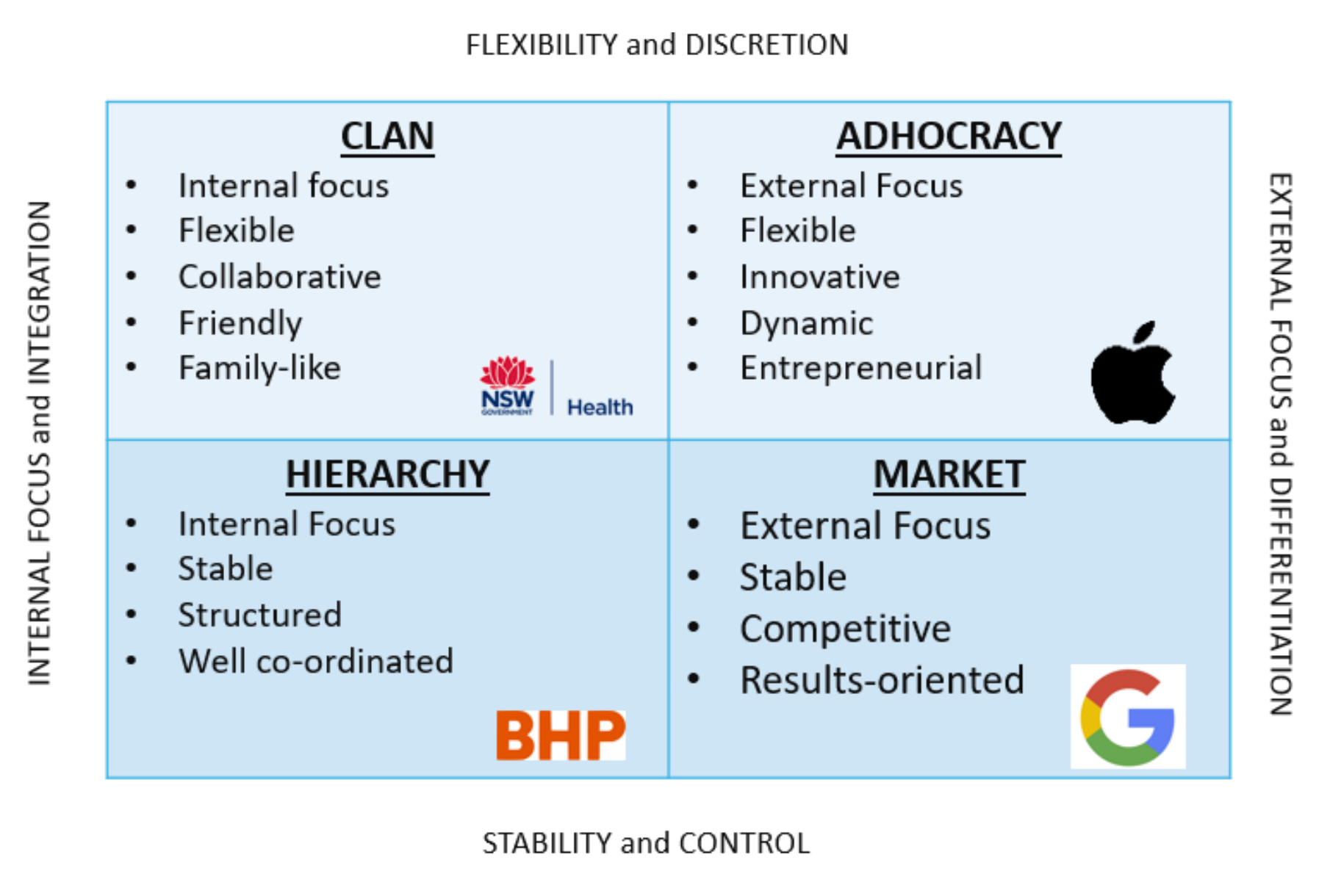
No organisation is at any given time any one of these archetypes, and there is always a natural tension between where the organisation is, compared to where the members would like it to be. There is an ongoing dynamic between the internal and external focus and whether the emphasis is on integration or differentiation. Many factors could influence the choices which value stability and control over flexibility and discretion or vice versa.

Even acknowledging that these competing values are forever in the dance of change, shifting the centre of gravity from one cultural archetype to another quadrant is far more challenging to accomplish than many in the field care to acknowledge. In the same way that a nick in a sapling is visible in the grown tree, so too does the influence of the founders run within the organisation’s DNA throughout its life.

It takes a very long time to learn to succeed in any given endeavour and the habits formed from learning how to succeed are not readily surrendered. We are far more ready to acknowledge when markets change, and our focus and comfort is found in what needs doing in the external competitiveness arena. It is far more challenging and takes much longer than we would ordinarily allow to co-create a new way of being in all the areas of internal integration outlined above.

In my next article, we’ll explore more deeply the subcultures present within most organisations as well as dig into the kinds of mental models we carry when assessing our place within a culture.

This is Part 1 of our series on Culture.

Part 1: Cultivating culture
Part 2: Culture – Digging below the surface
Part 3: The Anxieties of Changing Culture

____________________________

What’s next?

The change to using Theory of Constraints (TOC) as an underlying operating system is both profound and exhilarating. We’ve developed the Systems Thinker Course to bring the ideas into your organisation.

  • View the Systems Thinker Course Guide (no email required to download)
  • Join us for the Systems Thinker Foundations Workshop (we run this FREE workshop once each month)
  • To find out more about these, or any of our services, simply schedule a call
    ____________________________

    Man painting himself[Background image: Man painting himself, Marina Montoya on Unsplash]


    ____________________________

  • Culture
  • Operations
  • Process
  • Technology

Qairos: Architecting an Ontology of Flow

Ensemble Administrator

David Hodes, Founder

What if the central problem in project planning and execution is not poor reporting, weak discipline, or inconsistent delivery, but the fact that the underlying system was never designed to understand flow in the first place? Qairos starts from a different premise: that work should be modelled not merely as tasks, but as a living system of constraints, dependencies, queues, and throughput. These are the components of the ontology of flow.

The first question is no longer “Are we on track?” It is “Where is the constraint?”

Your dashboard is green. The cost performance index sits comfortably above 1. Resource utilisation looks strong. Tasks are being completed. Progress reviews suggest order, control, and predictability. Yet the project is drifting. Engineering approvals are backing up. Crews are busy but not moving the project. Materials arrive only to wait. Management sees comfort in the numbers while the system itself is quietly losing throughput. The issue is not that the organisation lacks sufficient data.

The issue is that it is not asking the right questions of the data to provide valuable information. This is not fundamentally an execution problem. It is an architectural problem. Traditional project systems are built around a deceptively simple assumption: that the task is the atomic unit of work. Everything rolls up from tasks. Tasks have budgets, durations, owners, and resources. But projects are not simply collections of independent tasks. They are interdependent systems of flow. The governing reality is not activity. It is dependency, capacity, delay, release, queue, and constraint. And in most conventional systems, those things do not exist natively in the model at all.

Why the system is not failing, but is doing what it was built to do.

Most industrial work management environments still carry the DNA of accounting systems. They are good at capturing costs, assigning budgets, tracking expenditures, and reporting variances. Scheduling was layered onto that worldview. Execution tools were added. Dashboards became more attractive. But the core paradigm did not change. The system still assumes that if enough local activities are monitored, the project’s global performance will somehow reveal itself. That assumption is wrong.

Flow is not missing from your reports. It is missing from your data model.

In any complex environment, throughput is governed by a constraint. The system moves only as fast as the slowest and most capacity-limited point in the chain of dependencies. Work can accumulate there. Downstream teams can idle or compensate with make-work. Upstream teams can generate inventory that has nowhere useful to go. None of this is unusual. It is the normal physics of work in an interdependent system. What is unusual is how thoroughly conventional project systems fail to represent it.

There is usually no native object for a constraint. No primary metric for queue depth. No mechanism for expressing how one process consumes work from another at a given rate. There are predecessor-successor links, but not a true ontology of flow. The result is that management receives precise visibility into local activity while remaining structurally blind to the behaviour that actually governs delivery.

Why do green dashboards so often coincide with poor outcomes?

Consider a major project where structural engineering approvals are the real bottleneck. Construction teams cannot progress critical work until designs are released. Procurement can deliver materials exactly as planned, but if approved drawings are late, those materials simply wait. Construction supervisors, pressured to keep crews productive, generate preparatory work, rework, or non-critical tasks. Resource utilisation stays high. Procurement performance looks strong. Cost variance remains acceptable. On the dashboard, nearly everything looks healthy.

But the project is not flowing.  The constraint is starving downstream throughput, while non-constraint functions optimise themselves around a false picture of success. This is the great deception of local metrics. They tell each part of the system that it is succeeding while the whole is deteriorating.

The system spends money efficiently on the wrong work

The problem is not that the reports are inaccurate. The problem is that they are measuring symptoms instead of causes. They can tell you that Task A is late or Resource Pool B is overloaded. They cannot tell you that the governing reason is a queue building upstream at the one point in the system that determines throughput.

The hidden damage done by the pursuit of utilisation

One of the clearest examples of this distortion is the treatment of utilisation. In traditional management logic, high utilisation is almost always read as a positive sign. It suggests productive labour, efficient supervision, and strong operational discipline. But in a system governed by constraints, non-constraint resources must have excess capacity by definition. Their role is not to remain fully occupied at all times. Their role is to support the constraint and protect the system’s throughput.

When management systems reward high utilisation indiscriminately, supervisors are pushed to keep people busy, whether or not the work contributes to flow. That pressure creates premature work, excess work-in-progress, rework, administrative noise, and inventory that has to be managed later. Labour is consumed, but throughput does not improve. In many cases, it worsens because the organisation devotes effort to competing activities rather than subordinating itself to the system’s needs.

High utilisation in the wrong place is not efficiency. It is expensive distraction.

The accounting view struggles to distinguish between labour spent advancing throughput and labour spent creating expensive distractions. Both consume hours. Both can look productive in reports. But one protects the system and the other burdens it.

Why intelligent people cannot fix a structurally blind system

Experienced leaders often sense that something is wrong. They recognise that the project appears busy but is not productive. They notice that certain approvals, interfaces, or decisions seem to govern the pace of everything else. But when they try to raise the issue, they are asked to show the data. And the system cannot provide it in a usable form.

There is no live queue-depth signal. No model of production and consumption rates between processes. No architecture that elevates the constraint into view. So even correct intuition struggles to become operational action. The issue is not a lack of intelligence-it is the absence of representational infrastructure.

You cannot manage what your system cannot represent.

At the same time, incentives reinforce the blindness. Construction managers are measured on crew utilisation and cost. Procurement teams are measured on delivery performance. Engineers are measured by their own commitments. Few, if any, are measured on system throughput. Everyone behaves rationally according to the metrics that govern them. The irrationality emerges at the level of the whole.

When projects fail, execution is blamed for architectural flaws

Once the pain is undeniable, organisations almost always diagnose the problem as an execution problem. They tighten controls, add oversight, increase reporting cadence, restructure teams, or replace leaders. Yet these interventions operate inside the same broken frame. They assume the model was sound and the people fell short. More often than not, the opposite is true: the people did exactly what the system told them to do.

It’s impossible to execute your way out of a planning and control architecture that cannot see the thing governing throughput.

If the system cannot identify the constraint, it cannot prioritise correctly. If it cannot prioritise correctly, it cannot subordinate non-critical work. If it cannot subordinate, then local success will continue to masquerade as global progress. What appears to be poor execution is frequently faithful execution of a structurally incorrect plan.

From measurement to intelligence

The real shift is not from one dashboard to a better dashboard. It is from measurement to intelligence. Measurement tells you what happened. Intelligence reveals what is happening, why it is happening, and what is likely to happen next.

In a flow architecture, dependencies are not merely sequences of tasks. They are explicit relationships between producing and consuming processes. Capacity is represented. Demand is represented. Queue tolerance is visible. The system can identify where work is accumulating, where release rates exceed processing rates, and where throughput is most exposed.

The system must be re-architected around flow as a native concept.

Constraint identification becomes the first organising principle rather than a secondary analytical exercise. The primary question changes. Instead of asking whether tasks are on schedule and budget, the organisation asks where the constraint is and whether the system is protecting it. Reporting changes accordingly. Queue depth at dependency points matters. Buffer consumption matters. Constraint load matters. Release logic matters. Task completion percentages become secondary rather than definitive.

Once this ontology is in place, genuinely intelligent control becomes possible. If a delay occurs, the system can rapidly identify the new governing point, recalculate the likely impact, and indicate which activities should pause, continue, or be redirected. Non-constrained resources can be prevented from working too far ahead and generating waste. Local optimisation becomes harder to sustain because the system itself embodies a different logic.

Why does this shift feel threatening to many organisations?

Better measurement is easy to welcome because it usually leaves authority structures intact. It provides richer reports, cleaner dashboards, and more polished governance rituals. Intelligence is different. It challenges the way decisions are made. It reveals misalignment in real time.

Intelligence forces uncomfortable questions about whether teams are pursuing the right objectives at all.

That is why true intelligence architecture is not simply a software procurement exercise. It is a capability shift. It demands a different understanding of work, different leadership habits, and different forms of accountability. It requires organisations to replace the comfort of descriptive metrics with the discipline of causal visibility.

The irreversible moment

There is a point at which the old worldview becomes impossible to recover. It comes when a delay is logged and, instead of waiting days for a variance report, the system immediately shows the shift in the governing constraint, highlights the downstream implications, and recommends how to avoid generating fresh waste.

What once required retrospective interpretation becomes immediate, operational sense-making.

Once leaders have experienced that, traditional reporting starts to feel theatrical. It becomes obvious that static green metrics can coexist with a system that is slowly choking itself. At that point, the shift is no longer conceptual. It becomes visceral. The organisation can see the difference between being informed about the past and being guided in the present.

Where does transformation begin?

The transformation does not begin with replacing every tool. It begins with changing the ontology. Dependency mapping must become explicit and non-negotiable. The organisation must define not merely which tasks follow which tasks, but which processes produce for which other processes, at what rate, with what capacity, and with what tolerance for waiting. Once that happens, the constraint becomes visible by design.

This is where Qairos enters the picture. Qairos is not simply another layer of reporting on top of traditional project controls. It represents a different way of modelling work, one in which flow is native, constraints are explicit, and intelligence emerges from the architecture itself. It recognises that the system should not merely record activity. It should help the enterprise understand the living dynamics that determine safe, timely, cost-effective delivery.

Rethinking work management starts with rethinking what the system can see.

That matters now more than ever. Major projects operate amid volatility, long supply chains, digital interdependence, regulatory pressure, and little tolerance for overruns. Constraints shift faster than periodic reporting can detect. By the time old systems explain where the problem was, the system has often moved on. In that environment, conventional measurement is not just outdated, it is structurally incompatible with the speed and complexity of the work.

Every project platform embodies a worldview. One worldview says that control comes from measuring tasks and maximising utilisation. The other says that control comes from understanding flow and governing the constraint. Qairos stands with the latter. It is an argument for a more intelligent ontology of work, one that makes the hidden physics of value delivery visible, actionable, and repeatable.

Qairos is architected around an ontology built for organisations that want more than retrospective reporting. It is for leaders who want to understand the true dynamics of flow, protect throughput, and make better value decisions as the work unfolds.

Book a call
View all articles

READ MORE

  • Language
  • Operations
  • Organisation
  • Process
  • Strategy

Measurably reliable and agile

David Hodes, Founder

Few performance standards deliver the competitive advantage you gain by keeping your promise to deliver on time, doing so faster than your competitors, and suffering no defects while you’re about it.(more…)

READ MORE

More than just work

Discover better ways to do better work.

Fresh insights, every Friday

We alternate our own actionable articles with three relevant links from other authorities.

We’ll only use your email address for this newsletter. No sales calls

Subscribe to 'Perspectives'

More Than Just Work
Weekly productivity insights

Subscribe
  • EnsembleConsultingGroup
  • Share Page
  • +61 2 9387 3955
  • info@EnsembleConsultingGroup.com

Site proudly designed by Brand Fibre

More than just work

Discover better ways to do better work.

Fresh insights, every Friday

We alternate our own actionable articles with three relevant links from other authorities.


We’ll only use your email address for this newsletter. No sales calls

What is to get in touch with you?


white_arrow white_bidirection_arrow arrow-right-green arrow-right-orange arrow-right arrow-left blue_arrow blue_round_arrow tick

Want us to get in touch with you?

 
Thank you for your interest. We will call you back.